
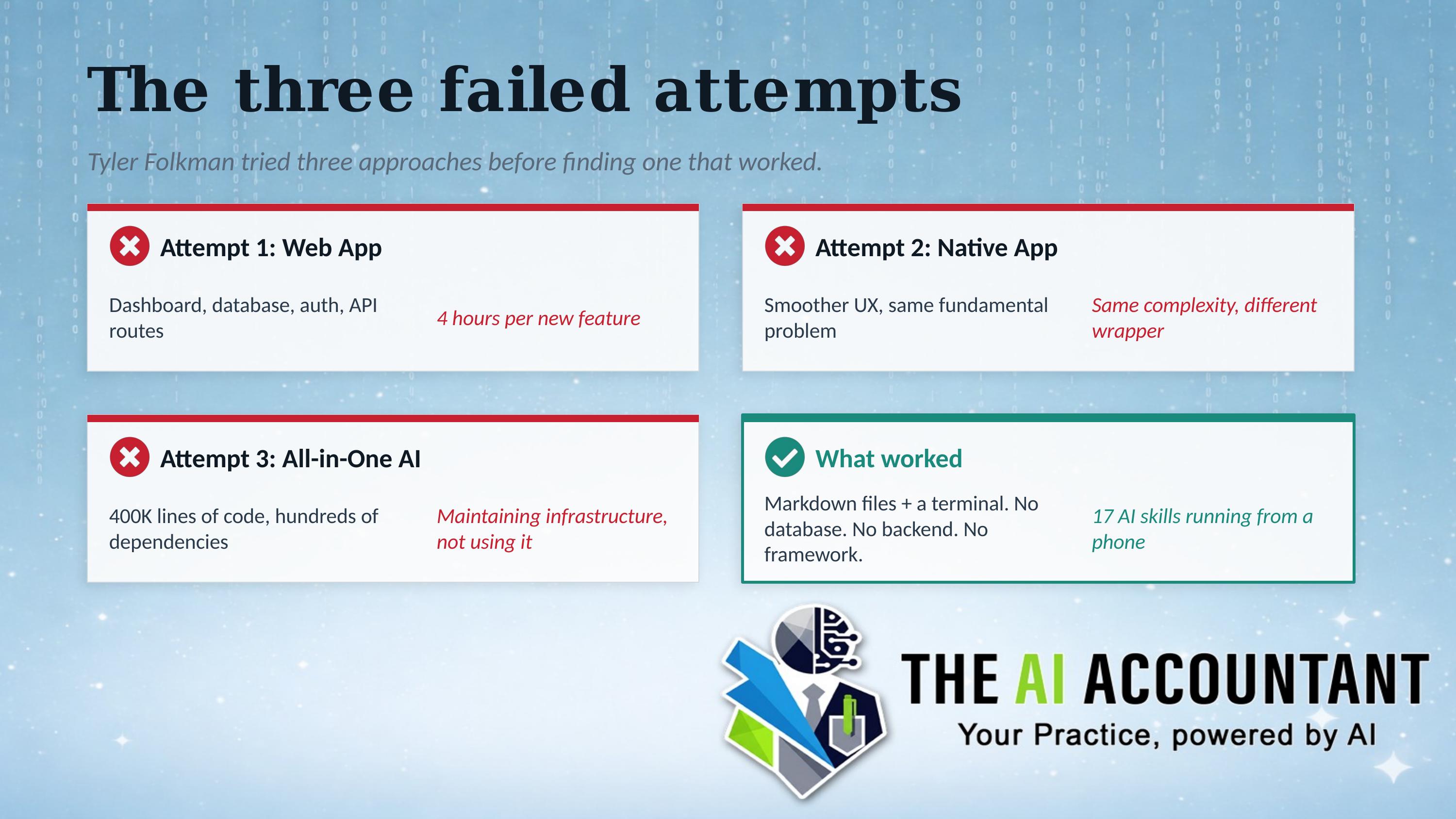
A software engineer spent weeks building the wrong thing. Tyler Folkman wanted AI to manage his life — workouts, meals, finances, guitar practice — so he did what engineers do. He built a web app. Dashboard. Database. Auth. API routes. The full stack.
It worked. Technically. But every new feature required a migration, a new endpoint, and a new UI component. Adding "track my sleep" took 4 hours minimum. He was spending more time maintaining the app than using it.
Then he tried a native app. Same problem. Then an all-in-one AI assistant with 400,000 lines of code and hundreds of dependencies. Same problem, scaled up.
So he deleted everything. And rebuilt it with markdown files and a terminal.
Today he runs 17 AI skills from his phone. Training coach. Meal planner. Financial advisor. Content engine. The entire system is five pieces: a personality file, a skills directory, a rules directory, daily notes with structured data, and a memory directory. No database. No backend. No dashboard. Plain text that AI can actually read, reference, and act on.
After 202 daily notes, the system knows him. It spots patterns he misses. It compounds — month one it's a fancy note-taker, month six it's a personalized operating system that gets better every day.
If you're running a CAS practice, this isn't a tech story. It's your competitive strategy spelled out in someone else's domain.
The dashboard trap is the bolt-on trap
Your profession is about to spend a fortune on AI dashboards. Every SaaS vendor in the accounting space is bolting "AI-powered" features onto existing tools — prettier interfaces, smarter-looking reports, chatbots that sit on top of the same old workflows.
Folkman tried that path. Three separate times. Dashboard, native app, all-in-one platform. Each one added complexity without changing outcomes. The breakthrough came when he stopped building interfaces and started building structured knowledge.
That's the lesson CAS firms need to hear. The firms that win the next three years won't be the ones with the best AI dashboard. They'll be the ones that have encoded their practice knowledge — SOPs, client playbooks, pricing logic, monthly close checklists, chart of accounts conventions — into formats AI can actually consume and act on.
That's context engineering. And it's the infrastructure most firms haven't started building.
Your workpapers are already the raw material
Here's what makes this directly applicable to your practice. You're already producing the artifacts. Monthly close packages. Client onboarding checklists. Bank rec procedures. Year-end file prep sequences. Engagement letter templates. Advisory frameworks.
The problem is format, not volume. Most of that knowledge lives in people's heads, in scattered email threads, or in Word documents no one updates. It's human-readable at best. It's not structured. It's not machine-readable. And it's not compounding.
Folkman's system works because every daily note he creates serves double duty — useful output today, context input for AI tomorrow. The CAS equivalent: every structured workpaper, every documented SOP, every client brief you build can serve the same dual purpose. Polished deliverable for your client right now. Training data for your AI systems going forward.
That's artifact engineering — the compounding flywheel. The more structured knowledge you produce, the smarter your AI systems become, the better your next deliverable gets, which produces more structured knowledge. It compounds. But only if you're building artifacts in formats AI can use.
Start with one workflow, not seventeen
Folkman's biggest mistake — his words — was planning 17 skills before shipping one. He wasted weekends on infrastructure for a system he hadn't validated.
The same trap is waiting for every CAS firm that tries to "transform the whole practice" in one push. Don't. Pick one workflow. Your monthly close process. Your client onboarding sequence. Your bank rec procedure. Document it in structured, machine-readable format. Build the AI workflow around it. Prove it compounds. Then expand.
Month one, it feels like extra documentation work. Month six, it's driving automated workflows your competitors haven't started building. Month twelve, you're operating at a structurally different speed — and the gap is widening every week.
The competitive moat isn't software. It's knowledge.
The firms investing in AI dashboards are buying someone else's interface. The firms encoding their own practice knowledge into structured systems are building something no vendor can replicate — a machine-readable version of what makes their practice unique. Your client context. Your delivery processes. Your pricing logic. Your advisory frameworks. That's the data edge, and it compounds in a way a dashboard subscription never will.
Stop building dashboards. Start building knowledge systems. The firms that figure this out first don't just move faster — they become impossible to catch.
Our AI Black Belt Training program teaches your team to build exactly this — structured workflows and machine-readable artifacts that compound over time. Five progressive disciplines, from workflow engineering through context engineering. The skills that turn scattered AI experiments into systems that actually scale. Visit theaiaccountant.ai/teams to learn more.