
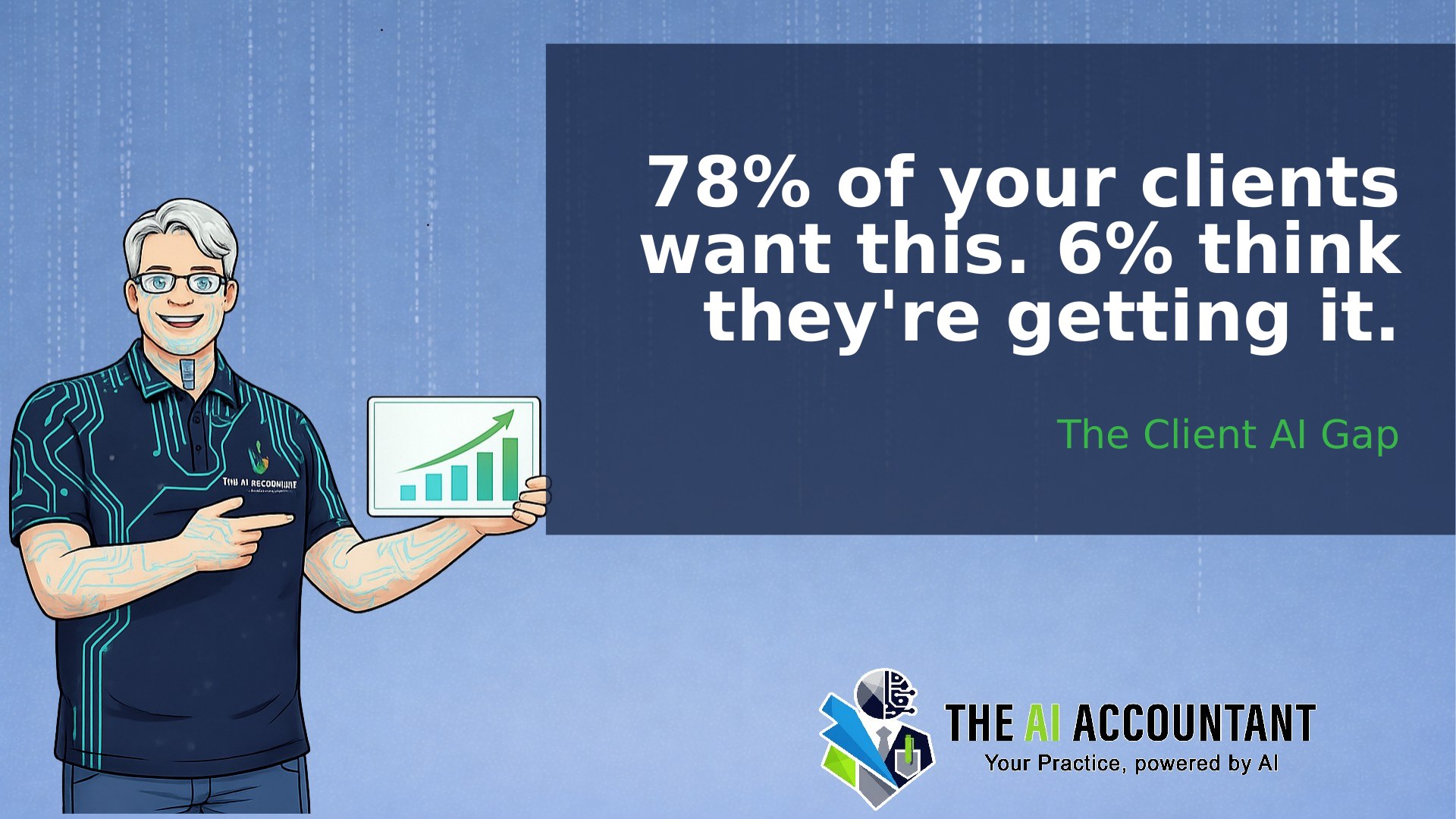
On June 22, Thomson Reuters released its fourth annual Future of Professionals report — a survey of 1,816 professionals across law, tax, audit, and accounting in 62 countries that includes the in-house corporate teams who buy professional services. Those buyers — the clients themselves — delivered the pair of numbers that should reorder your priorities: 78% say AI-enabled quality improvements from the firms they work with are very important or essential. Just 6% say they're getting them from most or all of their providers.
That's not an AI adoption stat. That's a customer satisfaction score — and it's the worst one this profession has ever been handed.
Your clients turned AI into a procurement question
Every survey of AI adoption in accounting we've covered this year measured the supply side: what firms are doing, buying, or planning. This is the first large dataset on what clients intend to do about it. Within the next 12 months, 32% of corporate clients say they'll be reconsidering relationships with providers they feel are falling behind on AI. A third of those put more than $1 million of annual work in play. Thomson Reuters extrapolates roughly $143 billion in US legal and accounting revenue under active reconsideration — treat that number as directional, not gospel, but the mechanism underneath it is solid.
Be clear about who's answering. Those numbers come from the corporate buyers inside TR's sample — general counsel, tax directors, compliance leads — rating the professional firms they engage across law, tax, audit, and accounting. That's clients speaking for themselves, not accountants guessing what their clients think. Two honest limits: TR doesn't publish how large that buyer subset is, and these are corporate buyers — upmarket of a typical CAS client list.
Which is where Intuit's 2026 Accountant Technology Survey comes in, released the very next day (725 US accounting professionals). It found 60% of practitioners say clients ask for proof of AI data protection frequently or always, and 84% agree strong AI security wins and keeps clients. The corporate market states the expectation directly; your market is already asking the questions. Neither is waiting for you to finish deciding.
What you sell a client who's repricing you on AI is its own question. That's Friday's piece — the close of the Squeeze series — on why compliance shouldn't be sold on its own anymore, and what to package it inside.
Your best people are running the same AI math
Thomson Reuters found that 24% of professionals who see a gap between what AI can do and what their firm delivers are considering leaving within two years — 13% within 12 months — at an estimated $232,000 replacement cost per professional. Among those already using professional-grade AI, 32% would turn down a role that didn't offer it.
Here's the uncomfortable part: almost half of senior leaders believe meaningful talent pressure is still at least three years away. The people setting the firm's pace are misreading the clock by about two years. If that gap is live in your firm, how you talk to your team about AI is where it gets fixed first.
"Undecided" on AI has a running cost
Not deciding doesn't look like doing nothing. It looks like buying things. Intuit's survey puts numbers on it: the average firm now runs 10 apps, only 41% have them fully integrated, teams lose around five hours a week moving data between systems, and firms spent about $21,000 on technology in the past year. That's spend without design.
It also forfeits the upside. A Ramp and Revelio Labs study of roughly 22,000 companies, released June 29, split AI adopters by depth rather than by yes/no. Companies investing at least $30 per employee per month in their first three months grew total headcount 10.2% — and entry-level headcount 12%. Companies that just bought subscriptions and ran pilots saw no gains at all.
Thomson Reuters' data explains why. Where AI strategies stall, the reasons are: tools not in place (47%), people not trained to work in the intended way (43%), strategy never translated into operational priorities (32%), and no shared understanding of the plan (30%). Not one of those says the AI wasn't good enough. Every one is a leadership and change problem.
The dividend goes to firms that decide, not firms that buy
Here's the number that ties it together. In firms with a named AI strategy, 66% of professionals say AI is meeting or exceeding expectations for creating value. Where there's no active strategy: 22%. Same technology, three times the result — and the report's own conclusion is blunt: "The decision to take a path matters more than the specific path you take."
One honest caveat: Thomson Reuters and Intuit both sell the cure they diagnose. Discount the marketing — then notice that two vendors with every incentive to tell you to buy a tool both concluded the gap is organizational, not technical.
This is what we teach in the AI Practice Transformation program: how your firm uses AI is first and foremost a strategic and leadership decision, not a technology decision. Buy the tool before you've defined the problem and you end up in the 22% — 10 apps, five lost hours a week, weak ROI. Get clear on the problems your firm is actually facing and what has to change to meet them, and tool selection becomes obvious — and a lot cheaper.
Your clients have put you on a 12-month clock. Your best people are on one, too. Our next AI Practice Transformation cohort starts this Friday, July 10 — four weeks, built to make your firm choose its path and put it into practice — and registration closes today, Wednesday July 8. Details at theaiaccountant.ai/transformation.