
Last week, in Part 1 of this series — You can't advise on what you haven't operated — I argued that the CAS firm that wants to advise its clients on AI has to first have operated it inside its own practice. That piece named four stages a firm can be at — Bolt-on (subscriptions, no shared context), Compressed (agents accelerating existing workflows), Rebuilt (workflows redesigned around AI), and Compounding (selling outcomes the firm couldn't build before). Most CAS firms are at Stage 1. Stage 3 — Rebuilt — is where the long-promised advisory transformation finally lives operationally, and Part 1 closed by naming the six-layer architecture that defines it. This piece is that architecture.
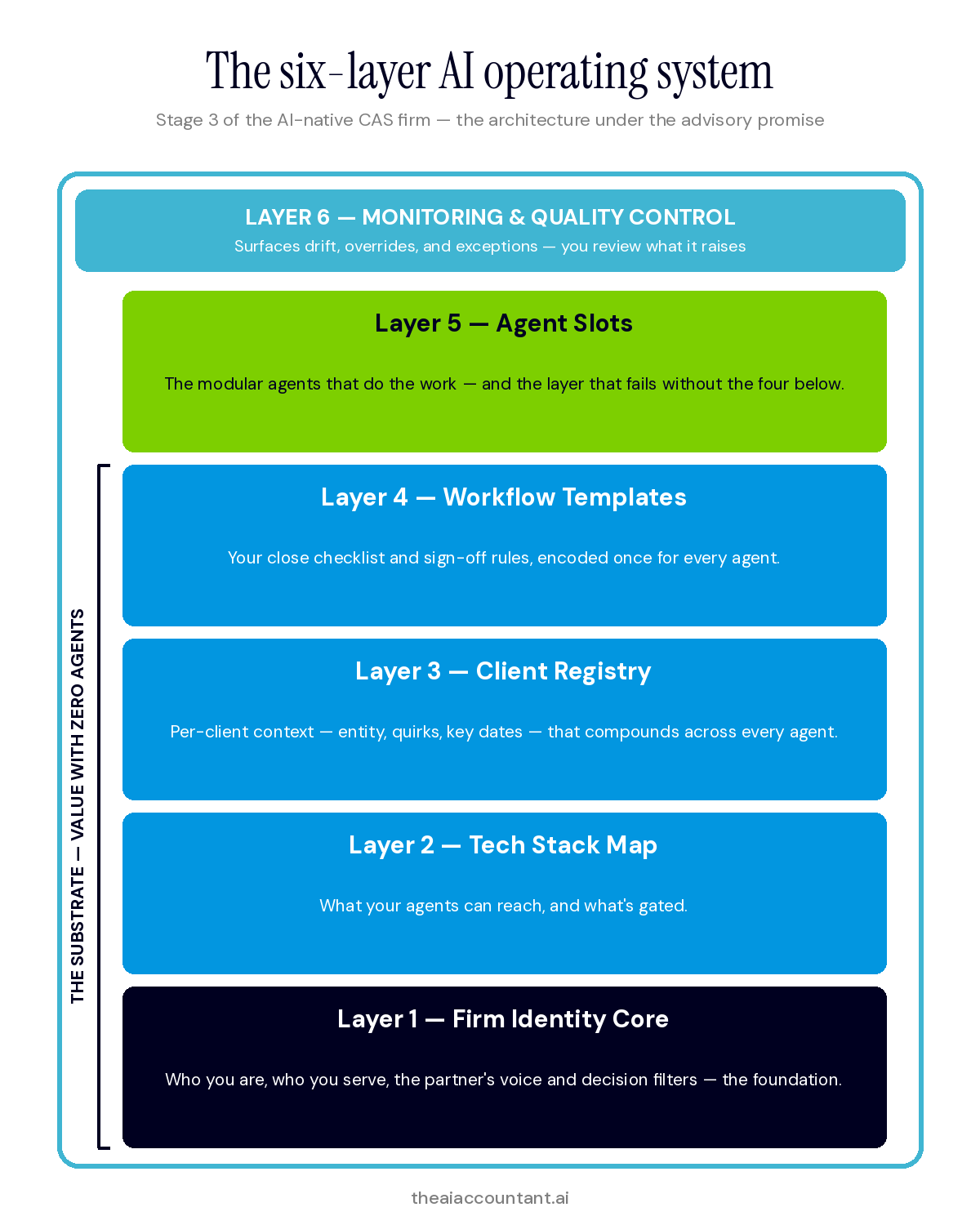
The build path between Stage 1 and Stage 3 runs through a definable architecture — six layers that, together, are the AI operating system an AI-native advisory practice actually runs on. We walk it layer by layer below. None of it is optional for the firm that wants to be the advisor.
The substrate — Layers 1 through 4 of the operating system
Layers 1-4 are the operational backbone of the practice. They have value before any agents run. Most CAS firms don't have them in deliberate form — they're scattered across people's heads, in a senior bookkeeper's institutional memory, in a partner's relationship knowledge. AI exposes the gap because agents need explicit context that humans carry implicitly.
Layer 1 — Firm Identity Core. Who you are, who you serve, who you decline. Names, roles, communication standards, engagement letter templates — and the partner's voice, mental models, decision filters, the firm's ideal client profile, the explicit anti-persona. Agents operating against Layer 1 inherit how this partner thinks, not a generic professional baseline. This is the layer that answers the question every skeptic asks first — won't an agent just produce generic output that doesn't sound like me?
Layer 2 — Tech Stack Map. Your accounting platform, practice management system, document storage, communication tools, payroll platform, tax software, client portal. What's connected, what's gated. Agents know what they can reach and what they can't.
Layer 3 — Client Registry. Per-client context — entity type, service tier, fiscal year-end, key dates, and the known quirks (commingled accounts, related parties, coding preferences). The categoriser agent knows this client treats equipment leases as operating expenses because the registry says so. Context compounds across every agent that touches a client.
Layer 4 — Workflow Templates. Your close checklist, client onboarding workflow, document request process, review and sign-off rules. Encoded once, available to every agent. Agents follow your process, not a textbook version.
The agents — Layer 5
Layer 5 — Agent Slots. The modular AI agents that plug into Layers 1-4 and inherit them — client status update drafter, bank reconciliation reviewer, month-end close preparer, tax document checklist tracker, engagement renewal tracker, advisory meeting prep builder, KPI dashboard generator. The agents that do the work, and the layer the catalog lives in.
Layer 5 is what most people picture when they hear "AI in a CAS firm." It's also the layer that produces the least value if Layers 1-4 don't exist. An agent with no firm context, no client context, no encoded workflow is a chatbot wearing your logo.
The discipline — Layer 6
Layer 6 — Monitoring & Quality Control. The correction log — what got overridden and why. Drift metrics — correction rate per agent over time. Recalibration cadence — when Layers 1 and 3 get refreshed. An exception register for items that escaped the agents' rules and required partner judgment. The name borrows your profession's own QC vocabulary, but the division of labour is the point: the operating system doesn't exercise the quality control — it surfaces what needs it. The drift, the overrides, the exceptions get raised continuously, and the partner's attention is concentrated where the work actually needs a human eye. The review a partner used to do by reading every file, the operating system narrows to the items that genuinely warrant it. Wednesday's piece — when bookkeeping costs cents, what's the human for? — argued that as the processing automates toward cents per transaction, quality control becomes the human's durable role and the new apprenticeship. Layer 6 is where that role gets institutionalized: not a vague commitment to "review," but a logged, measured discipline the operating system feeds.
Without Layer 6, agents drift and you don't notice until a client calls. With Layer 6, drift gets surfaced — and surfaced drift is drift a human can actually catch and correct before it reaches the client.
The infrastructure-first insight
Most firms approach AI as an initiative — a project with a budget, a start, a finish, and an output you can point to. Layers 1-4 reveal that framing is wrong. These layers aren't AI infrastructure. They're the operational backbone of any firm that wants to advise across clients consistently — they would matter even if AI didn't exist. Most CAS firms operate without them, successfully even — the scale is small enough that institutional memory works.
Capterra's 2026 survey quantified the cost of skipping this work. Forty-four percent of accounting buyers end up disappointed with their software purchases — the highest regret rate of any sector — and accountants are the least likely to define goals or perform risk assessments before buying. The pattern repeats with AI: 94% say they're adopting, but only 24% are doing it with structure. The rest are buying subscriptions without building the substrate.
AI makes the gap operationally fatal. Agents can't read your senior bookkeeper's mind. They can read a client registry. What you have to build for AI is what your firm has needed for a decade — independent of AI.
The work, not the workshop
The build from Stage 1 to Stage 3 is real work. It's also the work the advisory firm you've been promising to become would have done anyway — Layers 1-4 as operational discipline, Layer 5 as what runs on top, Layer 6 as what keeps it honest. Stage 4 — niche-specific products, on-demand advisory subscriptions, embedded operational intelligence as a service — is what the firm with the substrate can sell that the firm without it cannot.
Most firms won't build this. They'll buy another AI subscription and call it strategy. The firms that do build it claim the advisory position the profession has been talking about for a decade.
Book a free consultation at theaiaccountant.ai/consultation. We'll scope a build you'll do internally, or scope an outsourced engagement of the AI Operating System. We're building a done-for-you version for owners who want to outsource — the consultation is where we figure out which side your firm sits on.