
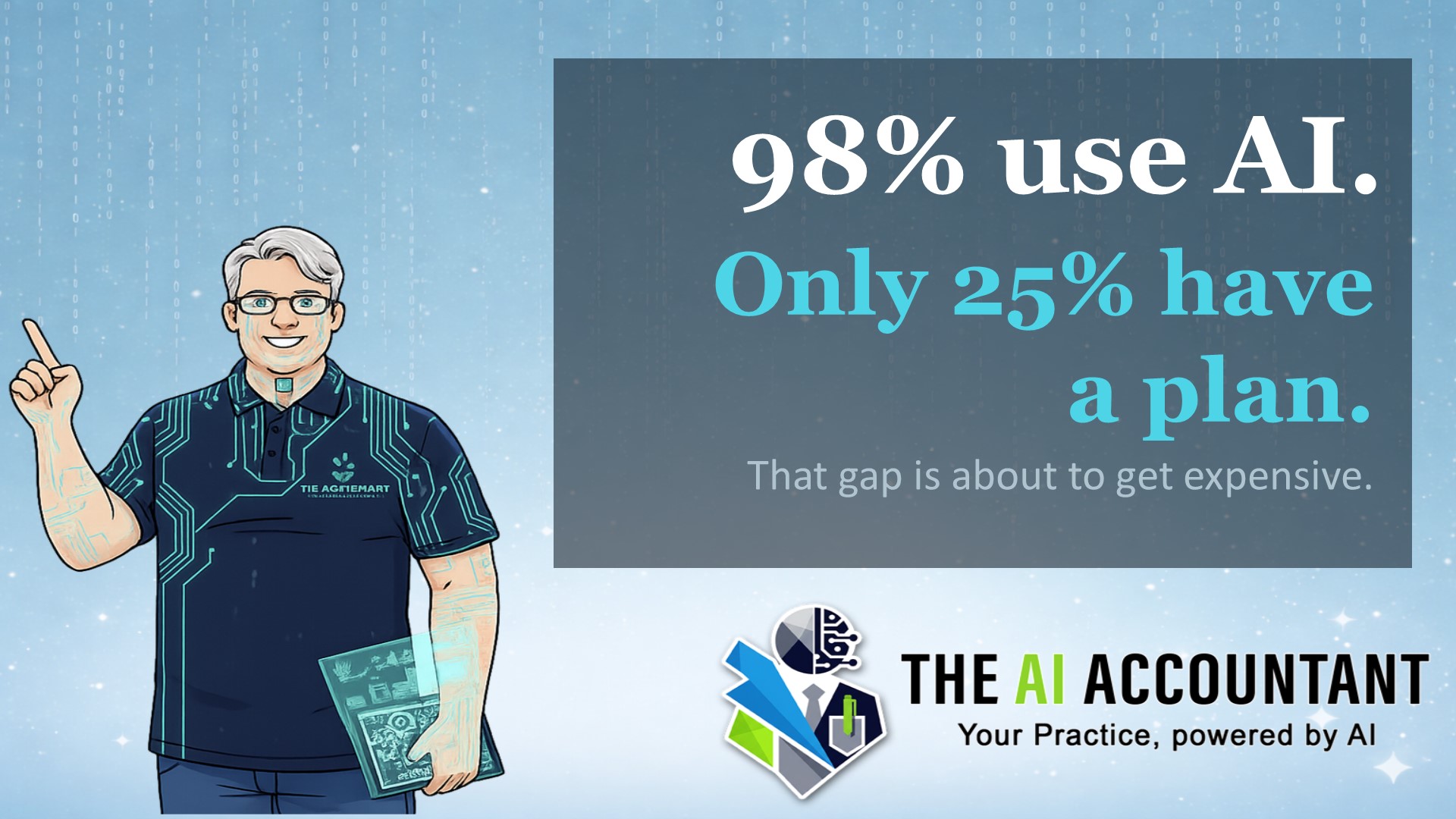
Karbon's 2026 State of AI in Accounting report dropped last week and the headline number looks like progress: 98% of firms now use AI, up from 85% in 2025. Daily and weekly usage sits at 88%. If you stopped reading there, you'd think the profession has this figured out.
Keep reading. Only 25% have a formal AI strategy. Only 41% offer any AI training. And just 13% have touched agentic AI — the technology that 57% to 79% of enterprises outside accounting are already running in production.
That's not adoption. That's tinkering. And the distance between tinkering and transformation is where the next wave of competitive separation happens.
The illusion of progress
Here's what tinkering looks like inside a CAS firm. One person uses ChatGPT to draft client emails. Someone else summarizes a tax article. A staff accountant experiments with categorizing transactions. It feels like the firm is "doing AI" — and technically, it is.
But none of it connects. There's no shared workflow. No documented process. No compounding effect where today's AI work makes tomorrow's faster. Every person is solving their own problems in isolation, and when they get busy — which is always — the experimentation stops.
The Karbon data confirms it. Firms report using AI for drafting communications (72%), research and summaries (64%), creating documents (55%), and bookkeeping tasks (50%). That's AI touching nearly every function in a practice — but without strategy, training, or integration between any of them. It's bolt-on thinking at scale. Lots of motion, no momentum.
Meanwhile, the rate of AI capability improvement nearly doubled in 2024, according to Epoch AI's analysis of frontier models. Inference costs have dropped 280-fold in under two years. The technology isn't waiting for your firm to build a strategy. It's accelerating whether you have one or not.
The fix isn't more experimenting. It's two decisions.
Most firms default to encouragement. "Play around with AI." "See what works." "We'll figure it out." That approach made sense in 2023. In 2026, it's a liability — because the firms that moved past experimentation are now operating at a fundamentally different speed.
Two structural decisions separate firms that are actually transforming from firms that are just tinkering.
Train your team on workflows, not tools
There's a critical difference between teaching someone to use ChatGPT and teaching them to rebuild a monthly close process around AI. The first gives you a person who can draft a faster email. The second gives you a practice that closes books in half the time.
The Karbon report shows 87% of practitioners are most excited about increased speed and efficiency. They want this. But speed doesn't come from scattered prompting — it comes from structured workflows where AI handles the repeatable steps and your team handles the judgment calls.
Think about what that looks like for your bank reconciliation process. Or your client onboarding. Or your year-end file prep. Each of those has a sequence of tasks — some require expertise, most don't. The firms pulling ahead aren't just using AI inside those workflows. They've redesigned the workflows around what AI makes possible. That's the difference between a 10% productivity bump and a 3x capacity increase.
Training your team on workflow engineering — not just tool usage — is what turns individual experiments into a firm that actually delivers faster. It's the difference between a firm where one person knows some AI tricks and a firm where the entire delivery model is faster.
Pick your champion — and it shouldn't be you
I made this mistake. I tried to be the AI champion inside my own practice. I'm the one who cared most, I understood the strategic stakes, and I figured I'd lead from the front.
It was a second, third, or fourth job. When client issues came up — the kind only I could handle — AI implementation got pushed aside. I missed learning windows. I lost opportunities I should have taken much, much sooner. The strategic importance of AI didn't protect it from the operational reality of running a practice.
Having someone else inside the firm be the primary driver — with me providing direction and them giving me pointers on what's working — would have significantly accelerated our adoption.
The Karbon data backs this up. Firms that offer training have more excited, engaged staff. Firms without training have more skeptical and scared teams. The person closest to the daily work — your senior accountant, your operations manager, your most curious staff member — is better positioned to identify friction points, test solutions, and build the repeatable processes that actually stick. They're in the workflows every day. You're not.
This is the champion model. Not someone who dabbles. Someone whose job explicitly includes driving AI adoption, with your support and authority behind them. The difference between firms that get traction and firms that keep "planning to get to AI" almost always comes down to whether someone specific owns it.
Angie, the owner of Reconciled Solutions, put it in terms every practice owner will recognize. She knew AI would change how her firm operates, but she also knew she wasn't the one to lead the implementation. So she signed up her lead accounting manager, Chris Graaf, for structured AI training. Chris dove in — and the results were immediate. The firm built a Client Strategy Hub that serves as a centralized source of client intelligence with four layers of depth. That's not a ChatGPT experiment. That's a new operating system for advisory delivery — and it came from giving the right person the right training and the authority to run with it.
The window is open, but it's narrowing
100% of firms in the Karbon survey reported positive impacts from AI. 52% reported zero negatives. The objections — accuracy concerns, data privacy worries, the "it's not ready yet" defense — are fading inside the profession itself. The problem isn't skepticism anymore. It's inertia.
Every month your firm operates without a trained team and a named champion is a month the firms that have both are compounding their advantage. They're building workflow libraries you don't have. Training institutional knowledge into AI systems you haven't started. Operating at a speed you can't match by hiring.
If your team is experimenting with AI but nothing is changing in how work actually gets delivered, the problem isn't effort. It's structure. Train your team on workflows. Pick your champion. Those two decisions are worth more than another year of "playing around with it."
Our AI Black Belt Training program is built for exactly this — giving your team a structured path from individual AI use to firm-wide workflow engineering. Five progressive disciplines. Repeatable systems your champion can own and your team can actually adopt. Visit theaiaccountant.ai to request team pricing.